
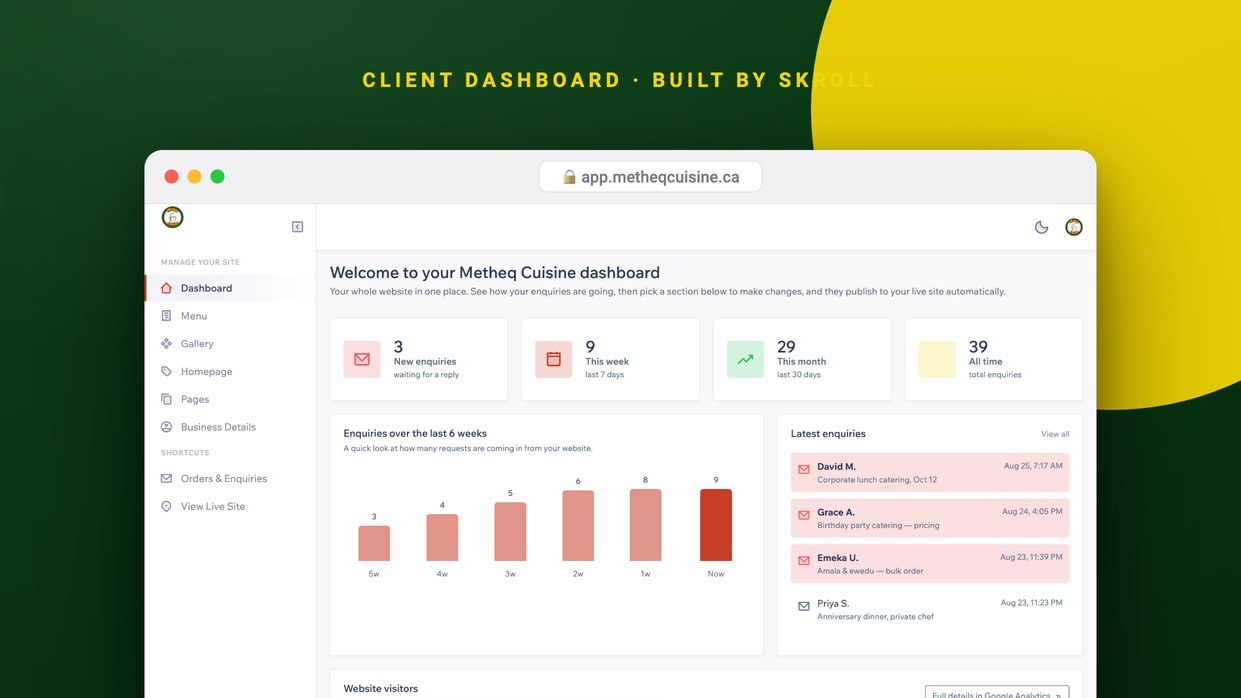
Plenty of small business owners can tell you how many visitors their website got last month. Far fewer can tell you how many of those visitors turned into a phone call, a form fill, or a paying customer. That gap is the whole problem.
A website is not a brochure you hang up and forget. It is a piece of business equipment, the same as a delivery van or a point-of-sale system. Equipment earns its keep by producing something you can count. If you cannot answer “what did my website actually produce this month,” you cannot tell whether it is working or just sitting there looking nice.
Why do traffic and rankings feel like progress when they aren’t?
Traffic is easy to check and easy to feel good about. A number goes up, and it feels like the site is doing its job. But a visitor who lands on your homepage, reads for ten seconds, and leaves is not worth anything to your business yet.
Rankings work the same way. Sitting on page one for a keyword matters only if that keyword brings people who actually want what you sell, and only if your site turns enough of them into leads once they arrive. A top ranking for a search nobody profitable is typing is a vanity metric with a nice screenshot.
None of this means traffic and rankings are useless. They are inputs. The output that matters is what happens after someone lands on the page.
What should you actually be measuring instead?
Three numbers tell you almost everything about whether a website is pulling its weight:
- Leads. Every phone call, form submission, booking, or chat message that starts on your website, not just the total number of sessions.
- Cost per lead. What you spend on the website and any marketing driving traffic to it, divided by the number of leads it produced in that period.
- Close rate and average sale value. What share of those leads become paying customers, and what a typical customer is worth. Without this, cost per lead is a number with no context.
Put those three together and you get a real answer: does the website bring in more value than it costs to run. Everything else, including traffic, is just a clue that helps you improve those three numbers.
How do you track calls and form submissions that started on your site?
Most small business sites already have the pieces. They just aren’t connected.
- Form submissions should land somewhere you can count them by month and by which page they came from, not just show up as an email you may or may not notice.
- Phone calls are the one most businesses miss entirely. A visitor who calls instead of filling out a form leaves no trace in most analytics setups. A separate tracking number on the website, distinct from the one on your storefront or business cards, tells you which calls actually started online.
- Click-to-call taps on mobile are worth tracking as their own event, since a huge share of local searches on a phone end in a tap, not a typed message.
None of this needs to be complicated. A single tracking number and a form that logs submissions with a source page attached will cover most small businesses.
What is cost per lead, and how do you work out yours?
Add up what the website actually costs in a given month or quarter: hosting, any ongoing design or development work, and the marketing spend driving people to it, whether that is SEO, ads, or both. Divide that by the number of leads the site produced in the same period.
A website that costs $300 a month to run and maintain and produces fifteen real leads a month is costing $20 per lead. Whether that is good or bad depends entirely on what a customer is worth to you. A roofer closing one job worth $8,000 out of every ten leads has a very different answer than a cafe where a lead is worth the price of a coffee.
This is also the number that makes a website cost easier to judge. A $1,450 build sounds expensive until you know it produced forty leads in its first quarter. It sounds expensive for a different reason if it produced zero.
How does a website compare to other ways of getting customers?
Once you have a real cost per lead from your website, compare it honestly to your other channels: a referral program, a trade show booth, paid ads on their own, or word of mouth. Most small businesses in Guelph, Kitchener-Waterloo, and across the GTA are running several of these at once without ever comparing them side by side.
A website usually wins this comparison over time because the same page keeps working long after you stop actively promoting it, unlike a booth or a boosted post that stops producing the moment you stop paying for it. But you only know that if you are tracking leads from each channel the same way, not guessing.
What if the numbers say your website isn’t converting?
If traffic is reasonable but leads are low, the problem is almost never “we need more visitors.” It is usually one of a short list of fixable things:
- The call to action is unclear or buried. Visitors should never have to hunt for how to contact you or what to do next.
- The site is slow or awkward on a phone. Most local traffic is mobile, and a clunky mobile experience quietly kills conversions before anyone reads your offer.
- The page doesn’t answer the actual question a visitor had. A service page that talks about your company instead of the customer’s problem loses people fast.
- There’s no reason to trust you yet. No reviews, no past work shown, no clear pricing or process, and a stranger has no reason to pick up the phone.
Fixing any of these is usually cheaper and faster than chasing more traffic to a page that was never going to convert it.
A simple monthly check worth doing
Pick one afternoon a month and run through this:
- Count leads from the website: forms, tracked calls, and bookings, by page if you can.
- Divide total website and marketing spend for the month by that lead count.
- Compare that cost per lead to what a customer is actually worth to you.
- Look at which one or two pages produced the most leads, and which produced none, then ask why.
That routine, kept up month after month, tells you more about your website than any traffic report ever will. If you would rather have this set up properly, tracked automatically, and reported in plain language, that is exactly the kind of work we do as part of digital marketing and SEO for clients across Ontario, alongside the web design and development that gets the conversion basics right in the first place.
If you are not sure whether your current site is earning its keep, get in touch and we will help you find out.

Join the conversation
Be the first to comment.